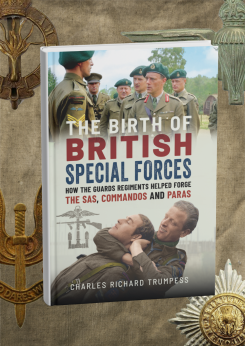
In the summer of 1940, with Britain standing alone against Nazi Germany, Winston Churchill issued a call for elite raiding forces capable of striking back at the enemy. What followed would transform the nature of modern warfare. The Commandos, the Long Range Desert Group (LRDG), the Special Air Service (SAS), and the Parachute Regiment all emerged from that moment of national crisis. But who conceived of them, and why were officers from Britain’s oldest and most traditional regiments so central to the task?
The Birth of British Special Forces provides the first systematic answer to that question.
Drawing on war diaries, personal papers, and recorded interviews with veterans, military historian Charles Trumpess demonstrates that officers of the Brigade of Guards were disproportionately represented in the founding of every major British special forces unit during the Second World War. Men such as Robert Laycock, Bill and David Stirling, and Frederick “Boy” Browning brought with them the aristocratic self-confidence, institutional connections, and willingness to challenge convention that enabled the establishment of experimental units, often in defiance of a resistant military establishment.
The book traces this influence across every theatre and phase of the war. From the earliest, improvised Commando raids on occupied Europe, through the LRDG’s reconnaissance missions across the North African desert, to the formation of the SAS behind enemy lines and the first British airborne operation, Operation Colossus, Trumpess builds a comprehensive and compelling case. Far from being incidental, the Guards’ connection was structural, shaping the selection, training, and operational culture of units whose methods continue to influence special forces to the present day.
The book does not shy away from controversy. It examines accusations of misuse and debates over manpower costs and operational effectiveness surrounding the employment of special forces throughout the war. It also traces the Guards’ connection to special forces beyond 1945, through the Cold War and into the modern era, including the formation of G Squadron SAS and the Guards Parachute Platoon.
The Birth of British Special Forces arrives at a moment of particular public interest in SAS origins, following the success of the BBC drama SAS: Rogue Heroes. Where that series delivered compelling drama, this book provides historical substance, offering the context and previously unexplored institutional connections that explain how and why these forces were created.
Why This Book Belongs on Your Shelf
If you are researching the origins of British special forces, the role of the Brigade of Guards in the Second World War, the formation of the SAS or Commandos, or the broader question of how elite military culture shapes unconventional warfare, this is an essential reference. No previous history has treated the Guards’ connection as the central, defining factor it was.
About the Author
Charles Trumpess is a military historian and Associate Fellow of the Royal Historical Society. He holds a Master’s degree in Military History by Research from the University of Buckingham and is a member of the Society of Authors, the Historical Writers’ Association, the Society for Army Historical Research, and the Army Records Society.
His first book, A History of the Guards Armoured Formations 1941–1945 (Pen & Sword Military), examined how the five regiments of the Foot Guards transitioned from elite infantry to armoured warfare during the Northwest Europe campaign. He manages The War Years (thewaryears.co.uk), a military history platform offering articles, video content, and research resources.
Charles is available for interviews, podcast and radio appearances, book signings, and academic events.
For review copies or interview requests, you can contact Charles via The War Years website and social media channels, such as LinkedIn and Facebook.